
Homeowners, commercial building owners and developers often need a variance to build or renovate structures on their Connecticut property. When clients are unable to get a specific project approved, we must think outside the box and come up with creative solutions to help them achieve their goals. Whether by finding a new path to comply with existing regulations or by getting new regulations passed, we have helped residential and commercial clients meet a broad range of real estate objectives.
Alternative to Proving a Hardship
FLB Law represented a family seeking to renovate their New Canaan home to accommodate their son who has a medical condition that requires him to use a wheelchair and avoid sun exposure. A local land use attorney in New Canaan declined to take the case, seeing no feasible way to achieve a favorable outcome. The homeowners wanted to add two pavilions next to their backyard pool, to allow their son to spend time with the family near the pool, and to enlarge their garage to accommodate a van for transporting their son and his wheelchair.
Typically, proving a legal hardship – which is a very high bar – is required to obtain a variance. The local attorney understood that the family’s situation did not rise to the level of legal hardship, but he didn’t have other strategies to pursue. We, on the other hand, took a different approach. We set out to prove that the pavilions and the garage renovations were reasonable accommodations under the Americans with Disabilities Act (ADA) and Fair Housing Act (FHA). We argued before the New Canaan Planning and Zoning Commission that if we could demonstrate that these were reasonable accommodations under those federal laws, we would not have to achieve the high threshold of proving a legal hardship. The zoning commission consulted with the town attorney, who agreed with our legal argument. At the hearing, we successfully showed that the requested accommodations were reasonable under the ADA and FHA, and the family was able to get their variance and make renovations to improve their quality of life.
Seeking Lot Coverage Relief for an Addition
Another Connecticut family sought lot coverage relief under the zoning regulations to build a 500-square-foot addition onto their approximately 2,000-square-foot historic home. Lot coverage refers to the percentage of a parcel that is allowed to be covered by buildings, patios, driveways and other impervious surfaces. The home sits on a small lot, and the desired addition – which the blended family sought to make room for kids returning from college – would push the total coverage over the allowable limit. Because the property was a historic structure, we originally sought approval under a regulation that allows the zoning commission to grant coverage relief for historic structures, to encourage property owners to preserve them in perpetuity. The regulation is based on the idea that permitting certain improvements gives property owners more incentive to keep the historic structure instead of building anew. The town, however, denied the relief mainly because the addition would impede neighbors’ water views.
We reached into our arsenal and succeeded under the town’s accessory dwelling unit (ADU) regulations. We found a loophole in the regulation that states that accessory buildings only need to be set back 15 feet from the property line. The architects were able to redesign the addition to comply with the setback. Therefore, we used the ADU regulations to secure approval for the family to build an even bigger addition as a separate unit on the same lot just 10 feet from the house.
Non-Residential Balconies
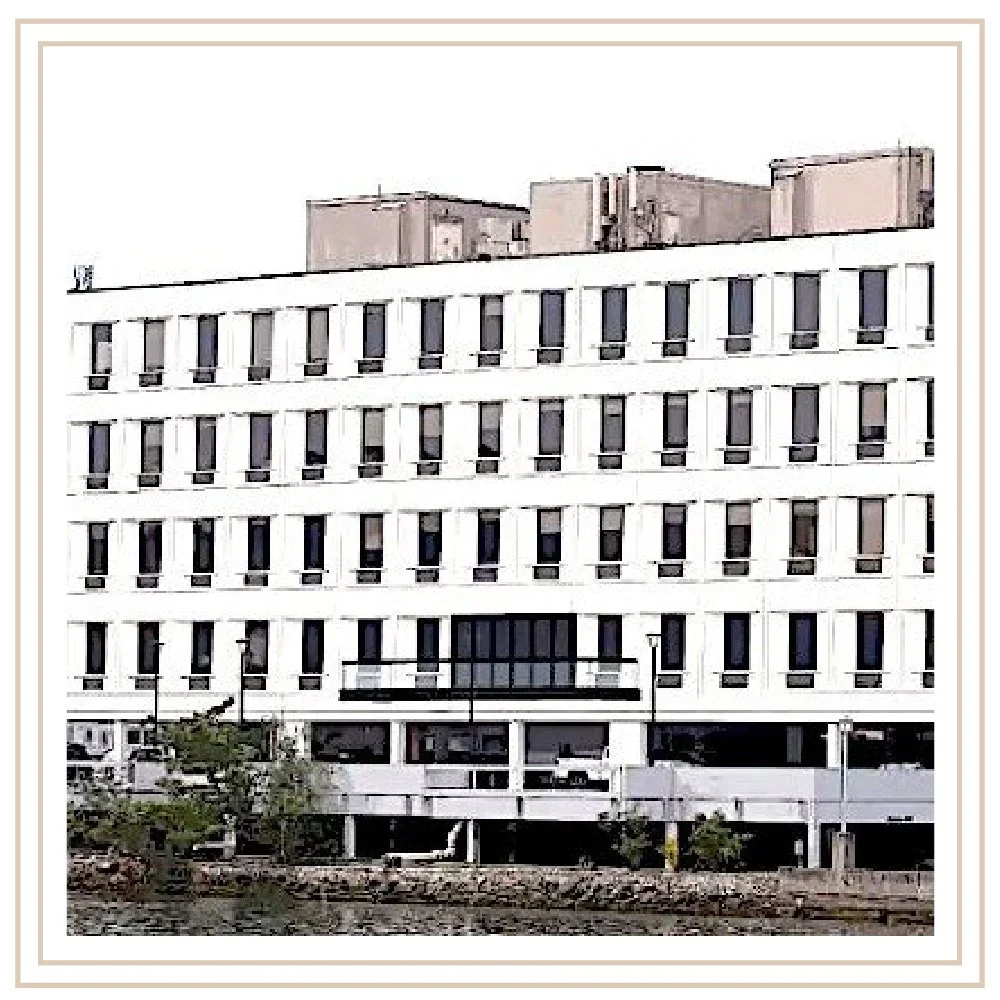
When existing regulations block a client’s real estate objectives, we turn to another tool in our toolbox: advocating for new regulations. For example, a tenant in an office building overlooking the Saugatuck River in Westport wanted to add a balcony to their unit facing the river. We secured approval from the Westport Planning and Zoning Commission for a zoning regulation text amendment that now permits up to two non-residential balconies on commercial buildings abutting the Saugatuck River.
The regulation amendment was necessary because the office buildings along the Saugatuck River are non-conforming and cannot generally be altered without a variance. The amended regulations exclude up to 500 square feet for each balcony from coverage and setback restrictions. After securing the regulation amendment on behalf of one client, we used it to allow another client to also build a balcony on a non-residential building.
In getting the regulation amended, we argued that balconies protect, preserve, and enhance visual access to the Saugatuck River, which is one of the objectives outlined in Westport’s Plan of Conservation and Development (POCD). The balconies also support the POCD by guiding business and economic development in Westport so that it is appropriate for the community and enhances community character.
Eric D. Bernheim, managing partner at FLB Law in Westport, Conn., represents tenants, developers, municipalities and lenders in transactions of all kinds, including leases, acquisitions, dispositions, and financing, in addition to handling zoning and land use matters. Contact Eric at bernheim@flb.law or 203.635.2200. For more information about FLB Law, click here.